I came across this framework in Human + Machine — and it feels even more relevant today.
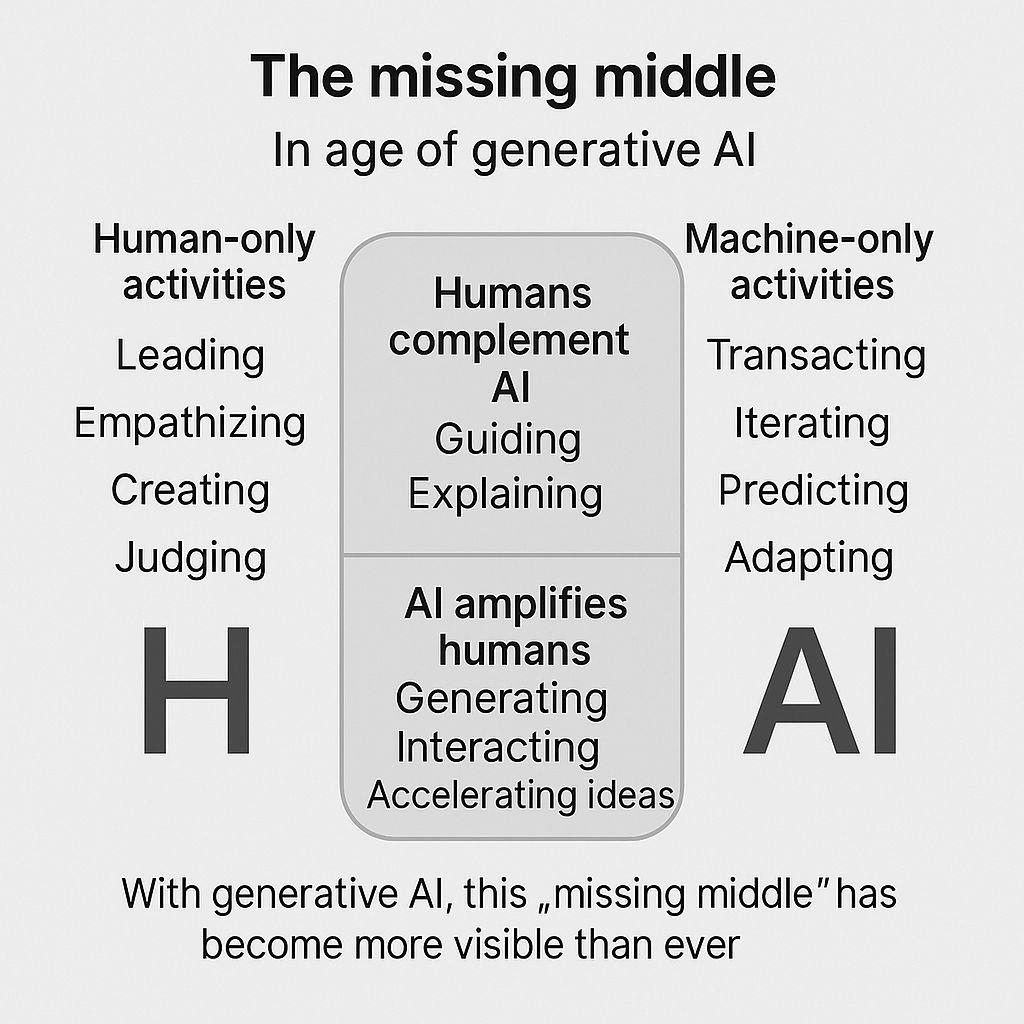
On one side: human-only activities — leading, empathising, creating, judging. Things that require context, relationships, and moral weight.
On the other: machine-only activities — transacting, iterating, predicting, adapting. Things that scale on data and computation.
But the interesting territory is the middle ground — where humans and AI work together in two distinct ways:
Humans complement AI by guiding it, explaining its outputs, and keeping it grounded in real-world constraints.
AI amplifies humans by generating options, accelerating ideas, and handling the parts of work that don’t require judgment.
With generative AI, this “missing middle” has become more visible than ever. It’s not about replacement — it’s about figuring out which side of the middle you want to operate on.
The question worth asking isn’t “will AI take my job?” It’s “am I building skills in the middle, or am I stuck at one of the poles?”