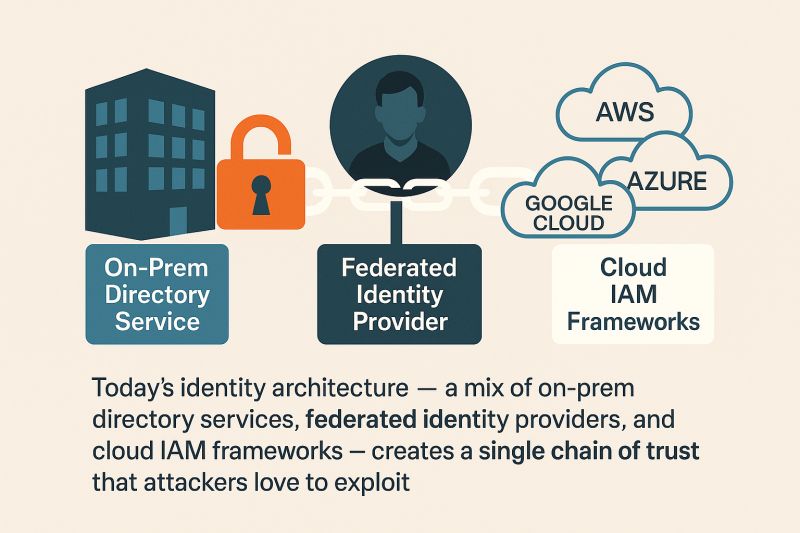
Identity Governance and Administration (IGA) did not appear as a complete discipline. It developed in stages as organizations added more users, applications, regulations, cloud services, and types of digital identity.
In the beginning, the challenge was to maintain a reliable directory and authenticate employees. The next challenge was to automate account provisioning. Then organizations needed to review access, enforce policy, and produce evidence for auditors. Today, they must govern access continuously across employees, contractors, workloads, service accounts, and AI agents.
IAM provides important context for this history, but this is not a story of IAM turning into IGA. The two disciplines evolved alongside each other: IAM delivered and enforced access, while IGA increasingly determined whether that access was appropriate, accountable, and explainable.
The clearest way to read the evolution is through a recurring pattern: every identity era solved an access problem—and created governance debt. Each advance expanded what organizations could connect or automate, while exposing a new question that IGA had to answer.
1990s–early 2000s: directory services created the foundation
The earliest enterprise identity challenge was centralization. Organizations needed a consistent way to store and manage information about users, groups, computers, and other network resources.
Directory technologies supplied that foundation. The first LDAP specification was published in 1993 as a lighter method of accessing X.500 directories. Active Directory later became a foundation for Windows 2000-based enterprise networks, providing hierarchical storage for users, computers, groups, and services.
During this era, identity management was largely directory-centric. Organizations focused on:
- Creating and maintaining user accounts
- Authenticating users to the corporate network
- Managing passwords and group membership
- Applying permissions to files and network resources
- Disabling accounts when employees left
These capabilities were essential, but limited. A directory could show that an account existed and which groups it belonged to. It could not easily explain whether the resulting access across many business applications was appropriate.
IGA did not yet exist as a mature product category. Governance was usually handled through manual approvals, application-owner knowledge, spreadsheets, and audit exercises.
What this era solved: LDAP and Active Directory gave enterprises a central place to store identities and manage users and groups.
What it left behind: Groups became a practical entitlement model, but their business meaning, ownership, and risk were rarely documented. Organizations could see group membership without reliably knowing whether the access was appropriate.
2000–2005: enterprise IAM focused on automation
As organizations digitized more business processes, every major application created another set of accounts and permissions to manage. Manual administration became too slow and inconsistent.
Enterprise IAM platforms emerged to automate common identity operations, including:
- User provisioning and deprovisioning
- Joiner, mover, and leaver processes
- Password synchronization and reset
- Single sign-on
- Workflow-based access requests
- Basic role and group assignment
The primary goal was operational efficiency. An HR event could trigger account creation in a directory and connected applications. When an employee changed jobs or left the organization, IAM workflows could update or remove access.
Federation also advanced during this period. SAML 2.0 became an OASIS standard in 2005, allowing authentication and attribute information to move between separate security domains.
IAM was becoming an enterprise integration layer, but governance remained underdeveloped. Most implementations were better at granting access than answering who approved it, why it was still needed, or whether combinations of entitlements created risk.
What this era solved: Provisioning, single sign-on, and password management accelerated the joiner process—often turning days of account setup into minutes.
What it left behind: Movers and leavers rarely received the same investment. Accounts and entitlements accumulated because automation was optimized for granting access more than validating or removing it.
2005–2010: IGA emerged as a distinct discipline
By the mid-2000s, organizations had accumulated large numbers of accounts, roles, groups, and application entitlements. Regulatory and audit requirements exposed a major weakness: automating access did not prove that the access was appropriate.
IGA emerged to address that problem.
SailPoint was founded in 2005 and described its 2007 release of IdentityIQ as an early identity-governance milestone. Other dedicated governance platforms also entered the market during this period. Their focus extended beyond account administration to the business decisions and evidence surrounding access.
Early IGA capabilities included:
- Access certification and periodic reviews
- Role-based access control
- Access requests and approvals
- Identity lifecycle governance
- Policy enforcement
- Segregation-of-duties analysis
- Compliance reporting and audit evidence
The defining questions of IGA became:
Who has access to what? Why do they have it? Who approved it? Does it violate policy? Should they keep it?
This era established the conceptual boundary that remains useful today: IAM delivers and enforces access, while IGA supplies governance, accountability, and oversight.
What this era solved: Certifications, RBAC, segregation-of-duties controls, and audit reporting produced evidence that access had been reviewed.
What it left behind: Evidence that a review occurred did not prove the decision was correct. Weak entitlement descriptions, limited business context, and oversized campaigns created reviewer fatigue and encouraged rubber-stamp approvals.
2010–2015: IGA matured into an enterprise program
During the next phase, organizations expanded IGA beyond individual compliance projects. Governance platforms connected to more directories, business applications, databases, and enterprise resource-planning systems.
IGA programs became more structured around:
- Enterprise access-request catalogs
- Application and entitlement ownership
- Role engineering and role mining
- Manager and application-owner certifications
- Automated policy checks during access requests
- Closed-loop remediation after a review
- Dashboards and audit-ready reporting
This period also revealed some of IGA’s lasting implementation challenges. Large connector programs took time. Role models became difficult to maintain. Reviewers received long certification lists without enough business context. Organizations sometimes reproduced poor access processes inside a new tool instead of redesigning them.
At the same time, cloud authorization standards were developing. OAuth 2.0 was standardized in 2012, and OpenID Connect became final in 2014. IAM increasingly supported federated and token-based access, while IGA had to extend governance beyond traditional on-premises accounts.
What this era solved: Federation enabled authentication across organizational and application boundaries, while enterprise IGA connected access requests, ownership, reviews, policy checks, and remediation.
What it left behind: Moving the authentication “front door” did not govern every authorization behind it. SSO without reliable provisioning and deprovisioning could leave orphaned accounts, while role sprawl and disconnected application permissions remained difficult to govern.
2015–2020: cloud and SaaS reshaped governance
Cloud adoption changed both the scale and location of identity. Business teams could adopt SaaS applications outside traditional IT deployment cycles, while users needed access from different devices and networks.
SCIM 2.0, standardized in 2015, provided a common protocol for cross-domain identity provisioning. Cloud-hosted IAM and IGA services also became more common, reducing some infrastructure overhead and accelerating integration through APIs and prebuilt connectors.
IGA evolved in several important ways:
- Governance expanded to SaaS and hybrid environments
- Access requests became more self-service
- Application onboarding became more template- and API-driven
- Risk scoring helped prioritize high-risk access
- Analytics supported role discovery and peer-group comparisons
- Recommendations began assisting reviewers and approvers
- IGA connected more closely with privileged-access and cloud-security tools
The purpose of IGA also broadened. Compliance remained important, but organizations increasingly treated identity governance as a security control. Excessive, orphaned, and inappropriate access were not only audit findings; they were paths an attacker could exploit.
Across the wider identity-security stack, MFA, privileged access management (PAM), FIDO2, and the emerging discipline of cloud infrastructure entitlement management (CIEM) reduced reliance on network location and strengthened control over high-risk access.
What this era solved: Cloud IGA, SCIM, APIs, analytics, and risk scoring extended governance into SaaS and hybrid environments.
What it left behind: Stronger authentication did not automatically produce correct authorization. Organizations could place a stronger lock on the front door while excessive privileges, unclear ownership, and poorly designed entitlements remained behind it.
2020–2023: identity-first security and continuous governance
Remote work, multi-cloud environments, and increasingly distributed applications weakened the value of the traditional network perimeter. Identity became one of the most reliable control points available to security teams.
NIST SP 800-207 formalized zero-trust principles in 2020, emphasizing explicit access decisions and removing implicit trust based only on network location or asset ownership.
For IGA, this created pressure to move beyond periodic governance. Annual or quarterly reviews could not always keep pace with rapidly changing access. Organizations began adopting:
- Event-driven lifecycle processing
- Risk-based access reviews
- Just-in-time and time-limited access
- More frequent entitlement discovery
- Automated removal of orphaned access
- Continuous policy monitoring
- Stronger integration between IGA, IAM, PAM, and security operations
The certification campaign did not disappear, but it became one control within a broader governance model. The direction shifted from proving compliance at a point in time toward maintaining appropriate access over time.
What this era solved: Zero-trust principles, event-driven lifecycle controls, risk signals, and just-in-time access challenged implicit trust and made governance more responsive to changing conditions.
What it left behind: Identity and access risk signals were distributed across IGA, IAM, PAM, CIEM, and security tools. Without shared context and ownership, continuous data could still produce fragmented decisions rather than continuous governance.
2023–present: IGA expands beyond the human workforce
The identity population is now much larger than the employee directory. Organizations must govern contractors, partners, service accounts, workloads, APIs, robotic-process automations, machine identities, and AI agents.
These identities do not always follow a traditional joiner, mover, and leaver lifecycle. Some are created automatically, operate for only a few minutes, possess powerful permissions, or act on behalf of another identity. Ownership can be unclear, and machine-speed actions can create risk before a quarterly review begins.
Modern IGA is therefore evolving toward:
- Continuous discovery of human and non-human identities
- Clear ownership for service accounts, workloads, and agents
- Governance of fine-grained permissions, not only accounts
- Short-lived and purpose-bound access
- Relationship-aware analysis across identities, resources, and activity
- Automated recommendations with explainable context
- Real-time policy evaluation and remediation
- Evidence that links machine actions to human or business authority
Artificial intelligence is also changing how IGA platforms analyze access. AI can help identify unusual entitlements, group similar access patterns, recommend reviewers, summarize risk, and suggest access removal. However, automation does not eliminate the need for accountable policy owners or reliable identity data. A recommendation is only useful when reviewers can understand the evidence behind it.
What this era is solving: Non-human identity discovery, workload identity, short-lived credentials, delegated authority, and agent-aware controls support automation at hybrid-cloud scale.
What it leaves behind: Many governance controls still assume that every identity has a manager, a periodic review cycle, and an employment end date. Machines and agents may have none of these, making ownership, purpose, scope, and traceability the next major IGA design challenge.
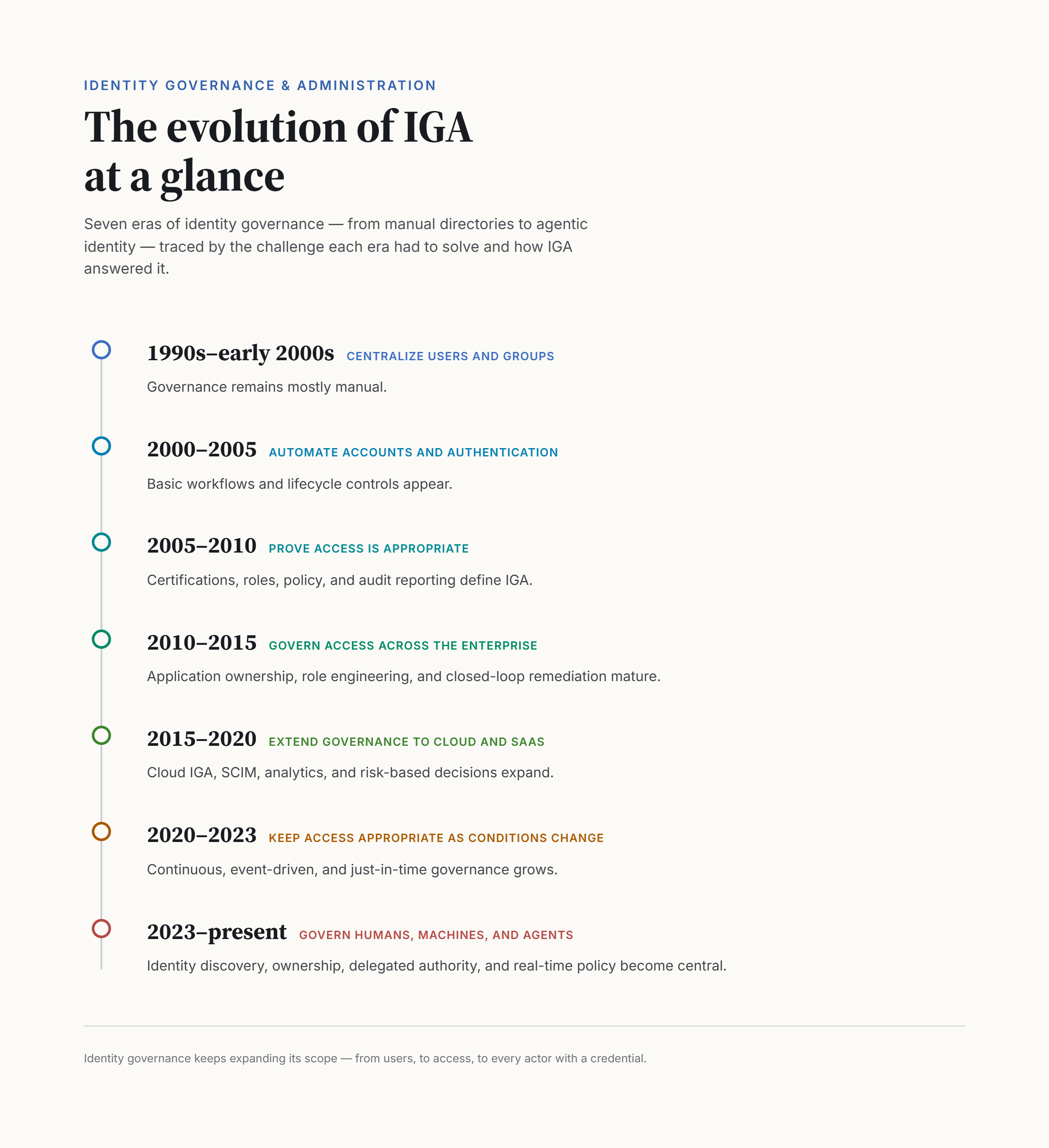
The evolution of IGA at a glance
| Era | Representative capabilities | What IGA had to govern next |
|---|---|---|
| 1990s–early 2000s | LDAP, Active Directory, users, and groups | Undocumented group meaning, manual approvals, and unclear ownership |
| 2000–2005 | Provisioning, SSO, password management, and lifecycle workflows | Access accumulation across movers, leavers, and disconnected applications |
| 2005–2010 | SOX-driven evidence, RBAC, SoD, certifications, and reporting | Review quality, business context, remediation, and accountable decisions |
| 2010–2015 | SAML, OAuth, OpenID Connect, enterprise catalogs, and role engineering | Authorization behind federation, orphaned accounts, and role sprawl |
| 2015–2020 | SCIM, cloud IGA, analytics, MFA, PAM, FIDO2, and CIEM | SaaS entitlement visibility, hybrid ownership, and excessive privilege |
| 2020–2023 | Zero trust, risk signals, event-driven controls, and just-in-time access | Continuous decisions across fragmented identity and security systems |
| 2023–present | Non-human identity, workloads, short-lived credentials, and agentic AI | Identities with no manager, review cycle, or natural end date |
What has remained constant
Although the technology has changed, effective IGA still depends on a few durable foundations:
- Reliable identity data: Governance decisions are only as good as their authoritative sources and account correlations.
- Clear ownership: Every application, entitlement, role, and non-human identity needs an accountable owner.
- Business context: Reviewers need to understand what access permits and why the identity requires it.
- Least privilege: Access should be limited by purpose, scope, and duration.
- Traceable decisions: Approvals, exceptions, policy results, and remediation must produce defensible evidence.
Where IGA is heading
IGA is moving from scheduled administration toward continuous decision-making. Future programs will likely rely less on large, repetitive certification campaigns and more on risk signals, event-driven controls, short-lived access, and targeted human review.
The boundaries between IGA, access management, privileged-access management, cloud-infrastructure entitlement management, and application authorization will also continue to narrow. Governance will need to follow an identity across these systems without losing business context or accountability.
The core purpose of IGA, however, remains unchanged: ensure that the right identity has the right access to the right resource, for the right reason, for no longer than necessary—and provide evidence that the organization can trust that decision.
References
- RFC 1487: X.500 Lightweight Directory Access Protocol
- Microsoft: Active Directory Domain Services
- OASIS: Security Assertion Markup Language 2.0
- SailPoint 2017 Form 10-K
- RFC 6749: The OAuth 2.0 Authorization Framework
- OpenID Connect Core 1.0
- RFC 7644: System for Cross-domain Identity Management
- FIDO Alliance: FIDO2 and W3C standards milestone
- Cloud Security Alliance: CIEM and cloud entitlement risk
- NIST SP 800-207: Zero Trust Architecture
- NIST SP 800-63-4: Digital Identity Guidelines